









A deep dive into a critical major league hitting adjustment
-

-

April 10, 2026 8:00 am
-

252 Comments
-

The best hitters in the world struggle against offspeed pitches and breaking balls at the highest level.
In 2025, Aaron Judge led all of baseball in batting average, on-base percentage, and slugging percentage, finishing the regular season with a .331/.457/.688 slash line, good for a 1.144 OPS. He led the American League with 124 walks, scored 137 runs, and mashed 53 big flies.
48 percent of the time, Judge saw some variation of a fastball: a four-seamer, sinker/two-seamer, or a cutter. Against those nearly 1,300 pitches, he hit a whopping .411 and slugged .871 with 36 home runs. Conversely, 52 percent of the time, Judge saw a non-fastball: an offspeed pitch (changeups, splitters) or a breaking pitch (sliders, sweepers, curveballs). Facing those offerings, his batting average dropped into the .200’s, and his whiff rate increased 20 percent when compared to fastballs.
The nature of offspeed and breaking offerings, with their associated movement, makes them more difficult for even elite batters to hit. It also leaves pitchers with the tall task of locating them, hence Judge and his great chase rate not seeing 90 percent non-fastballs.
It stands to reason that the most proficient offspeed and breaking pitch locators are in Major League Baseball, as opposed to the minor leagues. As such, big leaguers can throw non-fastballs more effectively and attack hitters’ weaknesses more frequently than arms at lower levels.
The discrepancy in command of offspeed and breaking pitches, even just from Triple-A to MLB, is significant, and is likely a big hurdle for many young hitters adjusting to the major league game.
In 2025, AAA pitchers threw nearly 300,000 offspeed and breaking pitches, and MLB pitchers threw about 10,000 more, according to Statcast. In AAA, pitchers landed 41 percent of those offerings for strikes, compared to 43.5 percent in the big leagues. A 2.5 percent difference, though it may sound small, is statistically significant with such a large sample size. In this case, it’s the difference of nearly 20,000 strikes.
Looking at the zone, you’ll find why the specifics of the location make a big difference.
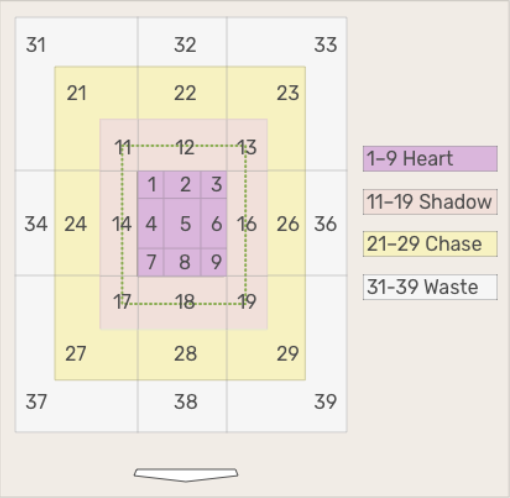
AAA pitchers were able to locate their offspeed and breaking pitches in the shadow of the zone, the most competitive place for pitches to land, 38.5 percent of the time, according to Statcast. That number took another 2.5 percent leap in MLB.
Big league pitchers seldom “waste,” either. Last season, according to Statcast, MLB arms threw waste offspeed and breaking offerings just 11.5 percent of the time, a number that jumped to 15 percent in AAA.
The general takeaway from the data is this: Compared to AAA arms, MLB pitchers are able to locate offspeed and breaking pitches in more competitive places more frequently. That was a logical assertion to begin with, but the data backs up its significance. Combine this fact with another logical assumption, that major league stuff (spin, shape) is also significantly better than that found in the minor leagues, and you’re left with a conclusion that’s simple: it’s a lot harder to hit offspeed and breaking pitches in the majors.
Take this generalized data and use it to help contextualize Colton Cowser’s start to 2026, for example.
Cowser, a former fifth-overall pick, has always showcased great plate discipline. He walked more than he struck out in his junior year at Sam Houston State, and a few years later, posted a .417 on-base percentage at Triple-A Norfolk.
A high on-base percentage is tested with every promotion. Though data for lower levels of the minors is less accessible, it’s reasonable to assume that as you move through the farm, waste pitches are less frequent, “misses” are closer, and general command is more consistent. Essentially, the higher you go, the harder it is to lay off non-fastballs. Cowser passed each test with flying colors, but the big leagues is the hardest exam of all. And as the data shows, it takes a significant step up from Triple-A.
When the outfielder has found success in the majors, it has largely been against fastballs, though he did perform well against curveballs and sliders in 2024. Against heaters, he has clubbed 29 of his 40 career home runs, and collected three of his four hits to begin 2026. Opposing pitchers have clearly seen this success, too, and are throwing Cowser fastballs just 29 percent of the time this season. The luxury of turning away from fastballs and still finding outs is a level of command generally reserved for the big leagues.
The outfielder has struggled against offspeed offerings in particular, and, as the data and logic suggests, is seeing the best stuff and command on those pitches of any point in his career, allowing pitchers to attack this area more frequently. Adjustments, such as getting back to his excellent chase rate from a season ago, will be necessary for Cowser to find more success against those offerings, and potentially see more fastballs in better counts as a result. The former perennial top-100 prospect, coming off of a season marred by injury, is certainly capable of a counter-punch.
Offspeed and breaking pitches are the hardest in the game to connect on, even for the game’s elite. There’s no greater challenge than doing so in MLB, where the quality of command takes a significant step up from even the highest level of the minor leagues.
252 Comments
Related Articles

Lack of execution and doing “little things” became big problem for Orioles
Any baseball conversation with Orioles bench coach Donnie Ecker reveals an interesting facet of his personality. Of a…
Read More
Orioles shut out again to complete sweep, elimination number is two, Albernaz angered by first-pitch swing
Gunnar Henderson chucked his helmet and bat, stripped off his protective padding and dumped it near home plate.…
Read More
Bautista on return: “It feels incredibly satisfying”
Félix Bautista made a commitment to come back to the Orioles this season after undergoing surgery in August…
Read More