








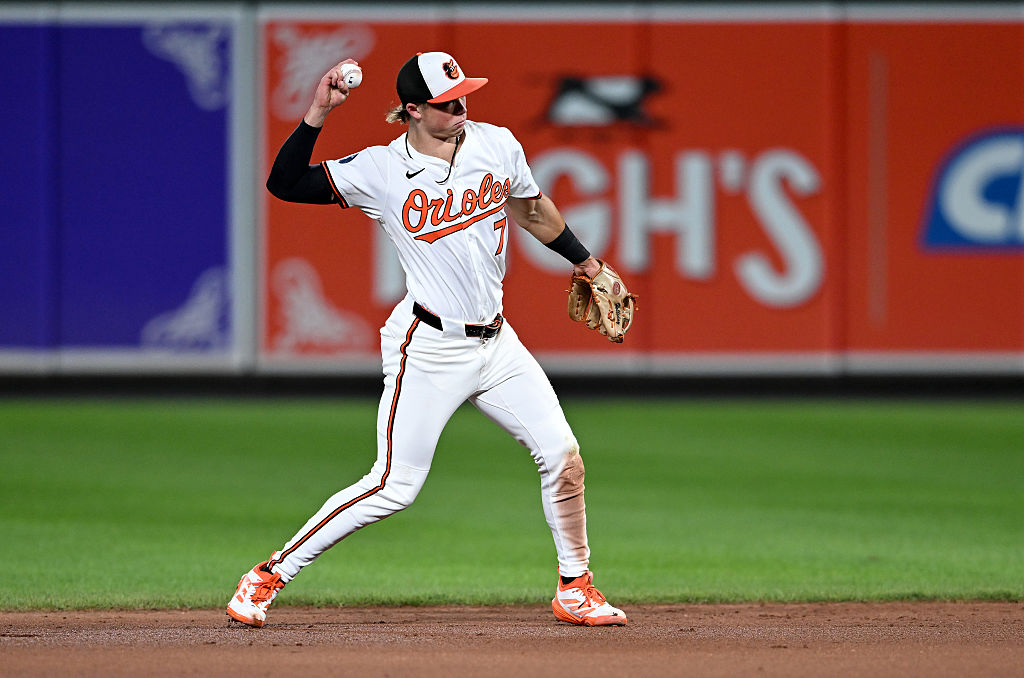
A closer look at Holliday’s potential fit at third base
-

-

May 11, 2026 8:00 am
-

196 Comments
-

Defensive versatility is a major point of emphasis in Baltimore. Even for No. 1 overall prospects.
Jackson Holliday, still working his way back from a hamate injury, will be working at a new position during his rehab assignment, according to manager Craig Albernaz.
“Yeah, he’s mixing in at third,” the skipper told the media last week. “We talked to him to see where his head was at, and he was for it.”
Holliday, a shortstop for most of his life and a majority of his minor league career, has spent almost all of his big league time at second base with franchise cornerstone Gunnar Henderson occupying short. Now, with Jordan Westburg’s uncertain status, Holliday could see some time back on the left side of the infield dirt.
“I think if you look at our roster, the versatility is something that we need,” Albernaz said. “We have Blaze who can play everywhere in the infield and go out in the outfield. With a lefty bat and Jackson’s background, his athleticism, just thinking through to see what it looks like and see how he feels about it so he has the ability to play second, short and third. We’ll see what it looks like when he gets down there.”
Though his natural position of shortstop is considered to be the most valuable, and the most difficult, defensive position in the infield, Holliday’s transition to second base wasn’t all smooth sailing. The former No. 1 overall pick ranked in the 5th percentile in outs above average, according to Statcast, and accumulated negative-10 defensive runs saved, according to FanGraphs.
And with third base being added to the mix, many have pointed to Holliday’s 26th percentile arm strength, according to Statcast, as a potential concern. But that metric can be a bit deceiving, as it’s very dependent upon the position you’re playing.
Take Jeremiah Jackson as an example.
In 2025, Jackson had the 42nd-strongest arm in Major League Baseball, according to Statcast. The top 10 percent of his throws from the outfield, where he played a majority of his games, averaged 91.1 mph.
This season, however, Jackson is down to No. 151 in arm strength. The top five percent of his throws from second base, where he now resides, average 79.9 mph.
There are a few possible explanations for this. The first is that Jackson’s arm strength suddenly and inexplicably disappeared from one year to the next, which feels unlikely. Another is that Jackson still has a strong arm, but he isn’t letting throws rip from second like he would in right field.
Let’s go with that reasoning, which brings us back to Holliday.
Sure, the former No. 1 prospect in the game was in the 26th percentile for arm strength a season ago, but that metric doesn’t tell the whole story. While the top five percent of his throws didn’t eclipse 81 mph on average, his maximum velocity was north of 88 mph. In fact, that 88.4 mph max velo would’ve ranked 26th among the 64 third basemen with at least 50 throws in 2025.
The natural shortstop has the arm to play third, but hasn’t had to showcase it much at second base.
Perhaps, then, many of Holliday’s struggles at second in 2025 can be attributed to the mechanical differences in switching sides of the infield rather than his arm talent or athleticism. A move to third base means staying on the left side, and, as such, perhaps fewer differences in footwork, transfers, throwing angles, etc..
“He was out there today taking ground balls, he looks really good,” Albernaz said of Holliday at third.
More than likely, Holliday will still see a lot of time at second base and serve as Henderson’s backup at shortstop. But for a team in need of a spark, Holliday could find himself inserted into the lineup at a few different places around the diamond.
196 Comments
Related Articles
Basallo on concussion list, Holliday to undergo wrist surgery
Catcher Samuel Basallo won’t play again over the last five games of the season. The Orioles placed Basallo…
Read More
Orioles place Samuel Basallo on concussion injured list, recall Heston Kjerstad
The Orioles have made the following roster moves: -Recalled OF Heston Kjerstad from Triple-A Norfolk. -Placed C Samuel Basallo on the 7-day…
Read More
Orioles first baseman Pete Alonso voted 2026 Most Valuable Oriole
The Orioles today announced that first baseman PETE ALONSO has been unanimously voted the winner of the 2026 Louis M.…
Read More