








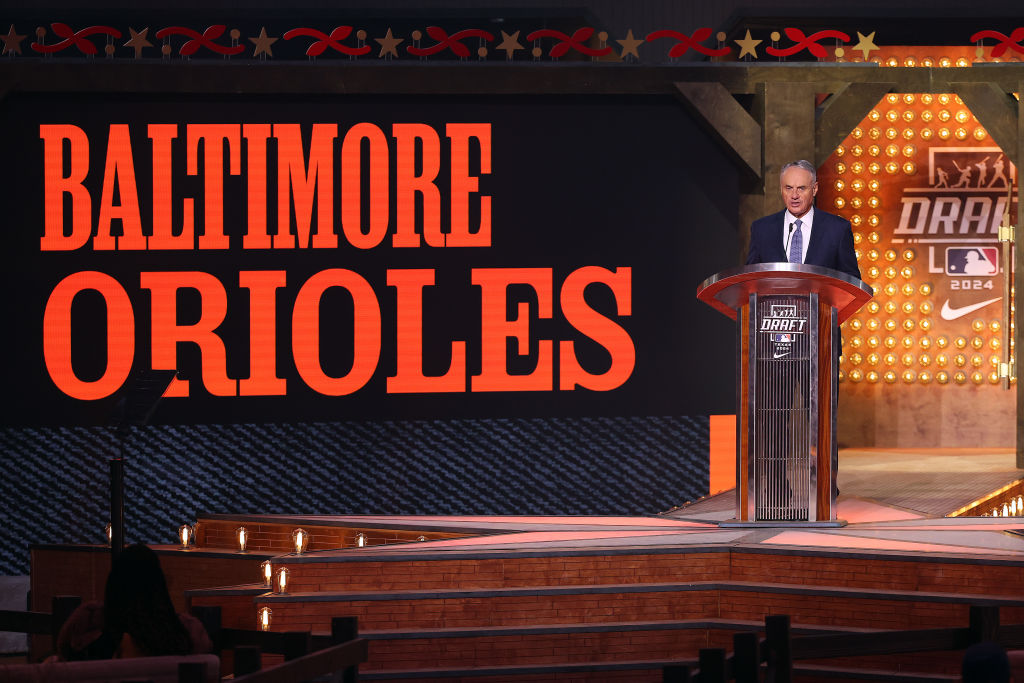
A final preview of the O’s No. 7 pick in the MLB Draft
-

-

July 10, 2026 8:00 am
-

0 Comments
-

We’re just one day away from the MLB Draft, and for the first time since 2022, the Orioles have a top-10 selection.
Unlike the early years of the Elias era, though, Baltimore won’t be selecting first, or even in the top-five. But at No. 7, the O’s still have a chance to add a premium talent to their farm system.
Be sure to tune into our MASN Orioles YouTube and Facebook channels for live coverage of the draft, starting tomorrow afternoon at roughly 1:30 p.m.. Hear from O’s front office members and scouts, experts from around the league, and Annie Klaff and I for instant analysis of Baltimore’s selection.
Here’s a final look at two players that have been tied most closely to the O’s leading up to the draft.
Eric Booth Jr.
If you’ve been following along with our “MASN All Access” draft content, you’ll know by now that there seems to be a consensus on the top six prospects in the draft. Three, Roch Cholowsky, Grady Emerson and Vahn Lackey, have almost no chance of falling to the Orioles at No. 7. It would be a shock to see Jackson Flora, widely considered to be the top pitching prospect available, drop down the board.
Jacob Lombard and Eric Booth Jr., a pair of high school hitters, are the final two. And since the MLB Draft is rarely chalk, there’s a decent chance that at least one falls to Baltimore. Take last year, as an example, where MLB Pipeline’s No. 18 prospect Tyler Bremner went No. 2 overall to the Los Angeles Angels. Let’s say at least one falls here.
Booth Jr. offers an incredibly exciting blend of speed and power. The center fielder is one of the fastest players in the high school class, and won the home run derby at a showcase last July. According to Pipeline, he makes consistent contact, barrels balls often, and has a good sense of the strike zone.
Generally, there are some more unknowns in drafting high school players as compared to their collegiate counterparts. But if Booth Jr. falls to the O’s pick at No. 7, he has a tool bag that could be too tantalizing to pass on.
Drew Burress
Here is the world in which the top six prospects are all drafted in the first six picks. In this scenario, the Orioles would likely be choosing from a crop of college hitters. Burress has been the one most commonly linked to the O’s.
An ultra productive center fielder from Georgia Tech, Burress rocketed a school-record 60 home runs for the Yellow Jackets with an OPS over 1.200. On a 20 to 80 scale, he is graded as at least a 55 in every tool, according to Pipeline.
The “knock” on Burress is his frame. He’s listed at 5 ‘9, with Pipeline noting that he’s shorter than that. Still, that hasn’t stopped him from producing loud exit velocities, commanding center field or nabbing some stolen bases.
Both Booth Jr. and Burress have profiles that the Orioles have typically targeted. They’re good athletes with power potential that make good swing decisions and play premium positions. Some first-rounders, like Vance Honeycutt and Enrique Bradfield Jr., have deviated from this structure in one way or another, but neither were drafted with top-of-the-first-round picks.
If Lombard is the high school bat that falls to No. 7 as opposed to Booth Jr., he’s a strong possibility for the pick, too. And while Burress is the college hitter that most have associated with the O’s, other options include Kentucky shortstop Tyler Bell, Arkansas catcher Ryder Helfrick, and LSU outfielder Derek Curiel, among others.
Since 2019, the Orioles have drafted and developed three No. 1 overall prospects in the game, according to Pipeline. And as of July 2, the bWAR of Baltimore’s homegrown players were the most of any team’s homegrown talent in baseball in that seven-year stretch.
Based on that strong track record, the No. 7 overall pick, whomever it is, could be the next in line.
0 Comments
Related Articles

Basallo on concussion list, Holliday to undergo wrist surgery
Catcher Samuel Basallo won’t play again over the last five games of the season. The Orioles placed Basallo…
Read More
Orioles place Samuel Basallo on concussion injured list, recall Heston Kjerstad
The Orioles have made the following roster moves: -Recalled OF Heston Kjerstad from Triple-A Norfolk. -Placed C Samuel Basallo on the 7-day…
Read More
Orioles first baseman Pete Alonso voted 2026 Most Valuable Oriole
The Orioles today announced that first baseman PETE ALONSO has been unanimously voted the winner of the 2026 Louis M.…
Read More