







Helsley explains why he signed with Orioles and won’t repeat his post-deadline struggles
-

-

December 03, 2025 5:39 pm
-

0 Comments
-


The Orioles were aggressive in their pursuit of free-agent closer Ryan Helsley, and he used the same approach to decide whether they were the right team for him.
Helsley met with club officials, reached out to former teammates with the Cardinals who also played for the Orioles, spoke with a friend who knows new manager Craig Albernaz. Helsley did his homework. And he’s confident that he made the right choice in accepting their two-year, $28 million offer with the opt-out clause.
“It just seemed like a great fit, honestly,” Helsley said earlier today in a video call. “Playing this team the last few years and seeing their young core and how tight-knit they were, and I’ve known a couple guys that have played with this group the last few years and they had very good things to say about them and the new coaching staff. I’ve heard a lot of great stuff about it, so that really drew me to come to Baltimore. And obviously, it has to be a two-way street in free agency and they were very interested, as well, and obviously we were able to strike a deal.”
Helsley can reenter free agency after the 2026 season, which might make him a one-and-done with the Orioles if he pitches at his previous All-Star level.
“To have an opt-out was big,” he said. “We had a few offers on the table, but obviously, we felt like Baltimore was the best. And not only the best offer, but the best fit. I couldn’t be more excited to be a part of this organization.”
The research done by Helsley led him to outfielder Tyler O’Neill and reliever Andrew Kittredge, who shared the same Cardinals clubhouse with him. And there were others with past ties.
“Yeah, I definitely reached out to them early in the process because Baltimore was one of the first teams to reach out and showed interest early on,” he said. “I also talked to Kyle Gibson and Jack Flaherty. I texted Dylan Carlson a little bit. So guys that I know who personally played there and experienced Baltimore and they all had great things to say about it, which obviously helped me make my decision a little easier.
“I heard from other teammates, too, about the coaching staff, and all the stuff I heard and all the positive feedback I got helped make this decision easy.”
Some teams toyed with the idea of signing Helsley to be a starter, a role he filled in college and the minors but never in the majors. The Orioles were quite clear about their intentions. They wanted Helsley to replace Félix Bautista, who underwent surgery to repair his labrum and rotator cuff.
“When they first reached out, that’s kind of what they said and what they envisioned for me and for my job to be with this team,” Helsley said. “Like I said, I’m just excited to be a part of it. Obviously, I know Andrew Kittredge is there and I think we’ll have a good bullpen. Hopefully, we can keep adding and make our team a little stronger.
“We’re in a tough division, so it’s going to be a lot of fun this year and a lot of tight games. Other teams offered the closer role, too, but I was lucky enough to have stuff to choose and pick from, which I think made it hard in itself, having options. But I’m thankful for that and I’m glad to be here.”
Helsley wanted word to spread in the industry that being in a rotation wasn’t a non-starter, so to speak.
“Starting was definitely real,” he said. “I told my agent at the start of the offseason that if teams ask, I’m willing to listen and open to it. Early in my career and started and had never pitched out of the bullpen until I got to the big leagues. We’ve seen Garrett Crochet and Seth Lugo, just to name a couple guys, who switched from the bullpen to starting roles and have had success. So something I was open to, something I’ve done before.
“Detroit was on me heavy for starting and just weighed the options and the risks and just didn’t seem to line up with where I was at in my career and what we were looking for as a team with Wasserman (agency).”
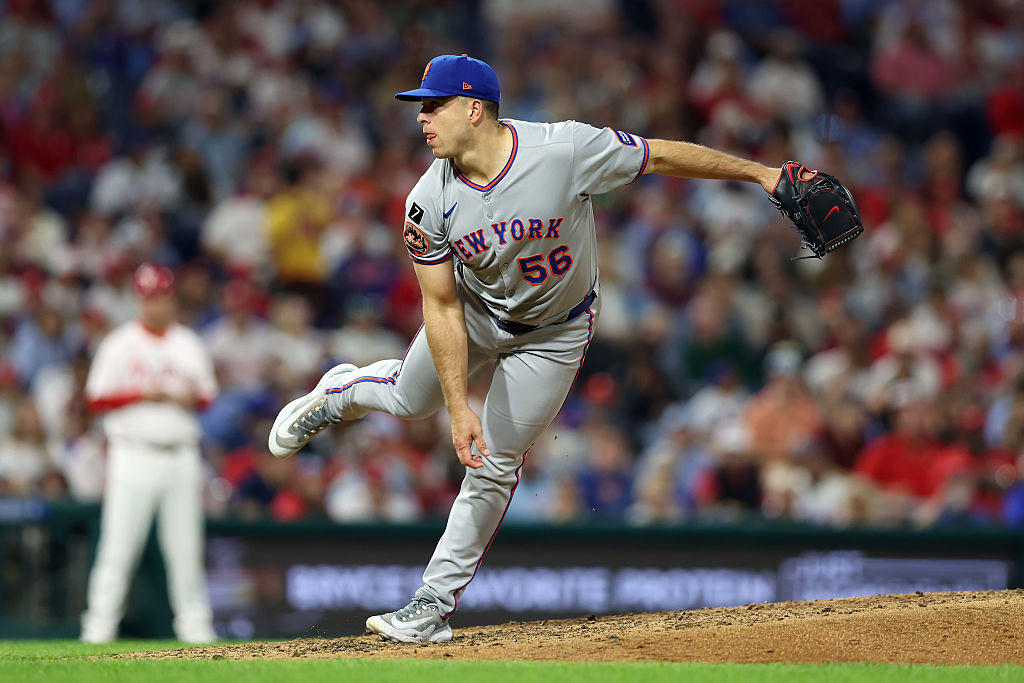
Helsley led the majors with 49 saves in 2024, made his second All-Star team and was chosen best reliever in the National League. His experience with the Mets after this year’s trade deadline was vastly different, with a 7.20 ERA and 1.800 WHIP in 22 appearances and with four blown saves in August. The last six outings were scoreless, which indicated that he fixed the glitch.
“I think it was just a combination of a little bit of everything – not making pitches and trying to adjust to the new role and maybe trying to do a little too much,” he said. “So I think it was just a little bit a combination of everything and having the ups and downs there. So I think that was a little bit of everything that contributed to that.”
Reports began to surface, which Helsley confirmed, that he was tipping his pitches, and it contributed, however much, to his issues. The Mets instructed him to drop his hands and keep them closer to his chest.
“Yeah, I think it was kind of like I said earlier, just a little bit of everything,” he said. “When I first got there, they told me they had stuff on me with their guys. They have some really good people over there. It seems like it’s all across the league now. There’s so many cameras and stuff. You’ve really got to be buttoned up on this type of thing because guys are going to take every little advantage they can get and try to make it a little easier for them to hit. But yeah, they had some stuff on me when I got there and I tried to work through it and thought I fixed it with my old mechanics and setup.
“Once you’re out there during the game, you’re not really thinking about that kind of stuff, so your old habits tend to creep back in. It wasn’t until I switched my posture and switched my hands that I think it really started to click, and obviously it was kind of a learning curve, an adjustment those first couple of outings trying to get used to my hands being there because it was so new and I pitched the same way for most of my career, so I think I got that ironed out and I think that would be something that will help me throughout the rest of my career.”
Opponents tattooed Helsley’s high-velocity fastball, batting .422 with a .667 slugging percentage. The pitch can reach triple digits but still leave a bat with similar velo.
“Yeah, I think a little bit of everything,” he said again. “I don’t know if there was just one thing we could really put our finger on. But I think being behind in counts and then throwing a fastball when a hitter’s looking for it obviously doesn’t help. These guys at this level are really good, and they show that on a day-to-day basis. And I’ve just got to be better at getting ahead, and I wasn’t as good when I was in New York at getting ahead as I had been with St. Louis this year and in years past. So just working on getting ahead and making better pitches with it, honestly, is what it boils down to, and not being so predictable.”
Arm angle was another point of focus. It became more vertical on his fastball, which he attributed perhaps to an injury that wasn’t related to his arm or shoulder.
“This year was not on purpose. That kind of just happened,” he said.
“I think I developed a little bit of, like, a foot issue in spring training, and that carried over the last couple of weeks and then reinforced it during the season. My arm raising that high was not by design, so I’m trying to get back to where my stuff has played at its best.
“We have a lot of tools in Baltimore and across the league now to be able to do that kind of stuff. The people in New York, they saw it right away, too, when I got there, and we were trying to work on it. I was trying to battle that and my hand posture, and when you’re pitching in close games or trying to close out a game in the big leagues in front of 45,000 people, you’re not really trying to think about too much stuff out there. It was hard to do that during the season, so I’m really trying to focus on that kind of stuff right now.
“They did a great job of pointing that out, and my last few outings, there’s a big difference in my arm angle and on all the models, just hitters’ reactions, everything was playing better. I think that was a really positive product from what they showed me and what we were working on that last month there.”
The Orioles will work with Helsley to make certain that he doesn’t regress again and can close out games with authority.
They need him to do it. They can’t go through a repeat of Craig Kimbrel’s disastrous second half in 2024 or the by-committee approach this year after Bautista’s latest injury, when track records didn’t exist and interim manager Tony Mansolino couldn’t really trust anyone to routinely protect leads.
“As far as what we talked about with Baltimore, yeah, we had some good discussions and they didn’t lay out a full detailed plan in our meetings before I signed, but they had some ideas, and they have the resources to help me get back to where I want to be and help me get that feel back on my fastball, maybe add a pitch or two or refine some things,” Helsley said.
“I think in this game you’re always trying to tweak and refine your stuff, and as long as you’re playing you’re always going to be doing that.”
0 Comments
Related Articles
Spring training leftovers for breakfast
SARASOTA – Former Orioles left-hander Scott McGregor exited camp yesterday after completing his five days as a guest…
Read More
Rogers: “If that’s the worst it’s gonna be on March 3, I’ll take it” (O’s lose 8-5)
SARASOTA – An exhibition game against a World Baseball Classic team wasn’t going to smudge Trevor Rogers’ spring…
Read More
McDermott among camp cuts, Orioles and Team Netherlands lineups (updated)
SARASOTA – The Orioles made their first round of camp cuts this morning, optioning reliever Chayce McDermott to…
Read More