








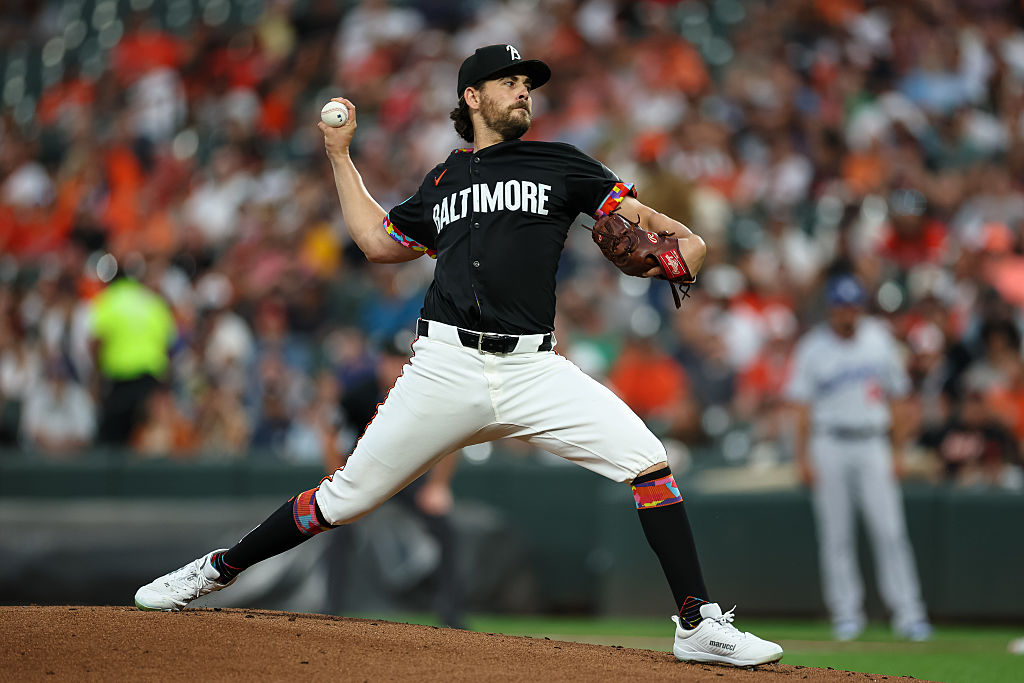
How a six-man rotation could make sense in Baltimore after Bassitt’s addition
-

-

February 13, 2026 8:00 am
-

34 Comments
-

Only four pitchers in baseball have thrown at least 170 innings in each of the past four seasons: Framber Valdez, Kevin Gausman, Logan Webb, and new Oriole Chris Bassitt.
The veteran posts.
During that stretch, in which he spent one year with the Mets and three with the Blue Jays, the 36-year-old has a 3.77 ERA in 126 games, striking out 8.6 batters per nine and walking 2.9. He’s faced over 3,000 batters and averaged 31.5 starts per year.
He joins an Orioles rotation that was lacking in the innings department last season, with just two pitchers, Dean Kremer and Shane Baz, appearing in at least 30 games in 2025. With no clear odd-man out, plus Kyle Bradish, Trevor Rogers and Zach Eflin all coming off seasons plagued by injury, could the O’s turn to a six-man rotation?
Kremer hasn’t been quite as dependable as Bassitt, but has still averaged close to 150 innings per season for the past four years. Baz has officially ramped up after missing all of 2023, tossing 166.1 innings last year.
Those are three arms that you can rely on to make 30 starts and toss 170 innings. The other three rotation candidates, however, are a different story.
Bradish is, of course, a lock for the rotation as the presumed Opening Day starter. Though he looked dominant in his first six games back from Tommy John surgery, the Orioles will still need to manage his innings this season.
Let’s use his new teammate, Baz, as an example.
The former top prospect returned to the mound in early May of 2024 after his Tommy John surgery in September of 2022. His rehab assignment featured 10 starts for the Triple-A Durham Bulls, in which he threw 39.1 innings. Combine that with his 79.1 innings at the big league level, and you’re left with an impressive 118.2 innings in his first season back. From there, it was a nearly 50 inning jump to 2026.
Bradish worked his way through rehab a bit quicker, needing only 22.0 innings in the minors before returning to the big leagues. 54.0 innings of quality baseball was an encouraging sign, but it takes a bit too much extrapolation to get to 170.0 innings in 2026, unless your name is Jacob DeGrom.
More realistically, with Baltimore surely cautious of their ace’s long-term future, a jump of about 50 to 75 innings could be expected. If Bradish carries forth his dominant pace from 2023, averaging about 5 ⅔ innings per start, he could complete 125.0 innings in about 22 outings.
If Baltimore opted for a six-man, Eflin, a full-go in camp after major back surgery, could see a workload similar to his 2018 season, in which he threw 128.0 innings in 24 contests. Since that campaign, the right-hander has an ERA just over 4.00.
Rogers, who pitched like an ace last season, doesn’t have as far to go to reach a full season’s workload after combining for over 142.0 innings in the minors and majors last year. His previous career-high in the big leagues is 133.0 innings pitched back in his All-Star season in 2021.
Health aside, there is one question that makes this calculus simpler: who would you realistically leave out?
Bradish, Rogers, Baz and Bassitt appear to be locks. Eflin has some experience as a reliever, but has put up excellent numbers as a starter, especially after his acquisition from the Rays at the 2024 deadline. Kremer has been the one true constant on Baltimore’s staff since 2022, with an ERA of 3.95 and at least 30 outings in two of the last three years.
Going with a six-man rotation could just kill two birds with one stone. The O’s could keep six talented starters in their rotation while limiting the number of innings required from Bradish, Rogers and Eflin, all of whom missed time with injuries in 2025. Of course, there are downsides, including throwing off habits and not seeing your most talented arms as frequently.
After a disappointing campaign riddled with injuries, the Orioles might just explore any possible way to keep their rotation healthy. A six-man rotation could do just that.
34 Comments
Related Articles
Bassitt starts slowly in Orioles’ 5-2 loss, Henderson hits first homer (updated)
Chris Bassitt will have much better days and nights with the Orioles. But he only gets one debut.…
Read More
MASN+ commonly asked questions
It’s been a month since we launched our new and improved website and app experiences. In that short…
Read More
Orioles and Rangers lineups for first night game
Blaze Alexander takes his turn tonight at second base for the Orioles in their series opener against the…
Read More