








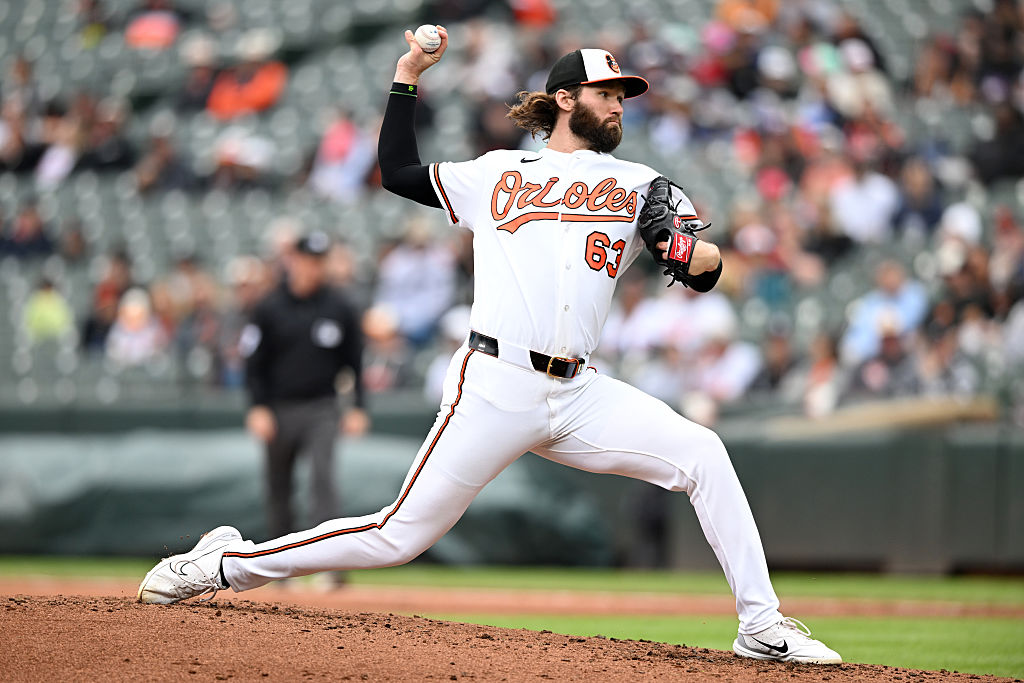
Orioles starters keying resurgence leading into next road trip
-

-

June 01, 2026 4:00 am
-

833 Comments
-

The Orioles weren’t going to even hint at turning around a disappointing start to their season if the rotation couldn’t pull its weight.
The wait might be over.
Kyle Bradish allowed an unearned run yesterday over seven innings to maintain his ace-like roll. To keep resembling the pitcher who finished fourth in Cy Young voting in 2023 and was even better in 2024 before blowing out his elbow.
Bradish has registered a 1.72 ERA in his last five starts, and his season ERA dropped yesterday from 3.86 to 3.44.
“He’s looked great,” said outfielder Colton Cowser. “I think that the work that he put in after those first however many starts to where he is now, that’s the Bradish we’ve all come to know, and it was really cool to see today.”
Brandon Young, who didn’t break camp with the team, posted a 2.86 ERA in five May starts to leave his season mark at 3.35 in eight games. Shane Baz has allowed five earned runs in 20 innings in his last three starts. Chris Bassitt, also new to the organization, has a 3.80 ERA over 21 1/3 innings in his last four starts.
Left-hander Trevor Rogers has posted a 6.84 ERA in 10 starts, but he carried a shutout into the seventh inning Friday before tiring and allowing a pair of two-run homers.
The rotation has produced a 2.38 ERA in the last 12 games since May 19. The group had a collective 5.24 ERA through May 18, the second worst in the majors.
It gets crazier. The starters have allowed two runs or fewer 10 times in 12 games and one or less eight times.
“At the end of the day, bad stretches only last for so long,” catcher Samuel Basallo said via interpreter Brandon Quinones. “You’re going to go through good stretches and bad stretches, both. I think right now we’re seeing a really good stretch out of the guys. They’re pitching very confidently and we’re seeing a lot of good stuff from them. Hopefully, they keep it going here.”
The season depends on it.
“I think it’s been incredible,” said assistant pitching coach Mitch Plassmeyer. “I think for those guys, as they progressed, they’ve done a great job in their midweek work of kind of addressing their individual needs and taking the approach of just attacking these guys, letting them put the ball in play, letting the defense work. So it’s definitely been more of an attack mindset these last couple weeks and it’s been paying off for them.”
Plassmeyer senses that the unit has turned a corner. And this time, without smacking into a wall.
“I think they’re on a positive trend right now,” he said. “I think the big thing for these guys is just continually to be competitive and kind of feed off each other. They’re a pretty tight-knit group and they’re learning from each other. They’re pretty locked into each other’s outings and seeing how teams are approaching the guy before them. So I think they’re taking kind of the notes from each game and applying it for the following one and keeping guys off balance pretty well right now.”
Young is one of the main catalysts for the staff’s turnaround, becoming more than just a depth piece.
The Orioles recalled Young on April 6, saw him toss five scoreless innings in Chicago and optioned him the next day. He returned on April 23 with Dean Kremer placed on the injured list and secured his spot.
Kremer still hasn’t gone on an injury rehab assignment, though he’s gradually able to increase his activities in Sarasota. No one is posing a threat to Young. No one has a lower ERA among the starters.
“I think he took a lot of stock in learning from last year’s ups and downs,” Plassmeyer said, “taking the good ones and identifying what he did well, but taking the ones that weren’t so good and being able to identify how he can clean that up, how he can turn lineups over better, how he needs to execute, how he needs to attack guys, and not making things bigger than it needs to be.
“He’s always been able to execute and had really good command. I think it’s just how are guys adjusting to him and making better in-game adjustments when people adjust back.”
A new grip on the splitter also deserves some credit. Young threw it 25 times Sunday and his average velocity on the pitch dropped from 87.7 mph last season to 82.8. The average spin rate also decreased, but his vertical break increased by eight inches.
A larger gap in velos between the four-seam fastball and splitter proved beneficial.
“Last year, the splitter was a new pitch for him, so obviously it was kind of new to the league and guys really hadn’t seen it before,” Plassmeyer said. “So now it’s on the report to start the year, and guys kind of adjusted to it, so he made the adjustment back of trying to kill some velo on it, kill some spin, add some depth, just to be able to get to those locations in a little bit different way. Play a little bit more front to back game. So I think it was a great identification by him that he needed to make an adjustment and went to work on it, and it’s paid off for him.”
Baz is starting Tuesday night’s series opener in Boston, followed by Bassitt on Wednesday night. They arrived with varying expectations, Baz slotted higher after costing the Orioles four minor leaguers and a competitive balance pick in a trade and receiving a five-year, $68 million extension before throwing his first pitch with the Orioles. Bassitt agreed to a one-year, $18.5 million contract in February after the team reported to camp.
“When you come in, I think it’s just a little bit different culture,” Plassmeyer said. “You’ve got new catchers, guys are kind of learning you as you navigate outings. I think everybody’s a little bit different in that regard. And you know, some of those guys like those two, Baz and Bassitt specifically, how they attack hitters throughout the game, how they turn lineups over, I think it just takes time for us to learn them, them to learn us, and kind of see where we can help them. And their feedback’s been really important in them kind of turning the corner.”
833 Comments
Related Articles
The latest Alonso award in an empty season for Orioles
The Sporting News is still a thing, in digital form only. And the outlet still publishes its major…
Read More
“The Bird’s Nest” reacts to the addition of Jared Banner in Baltimore
It feels strange to say that the Orioles need to make strides in their player development. The club…
Read More
Wondering about possible and unlikely returnees to Orioles in 2027
MASN aired an “Orioles Classic” yesterday from April 11, 2023, when Ryan Mountcastle finished with nine RBIs to…
Read More