








The oddities of the O’s offense to begin the season
-

-

April 23, 2026 8:00 am
-

112 Comments
-

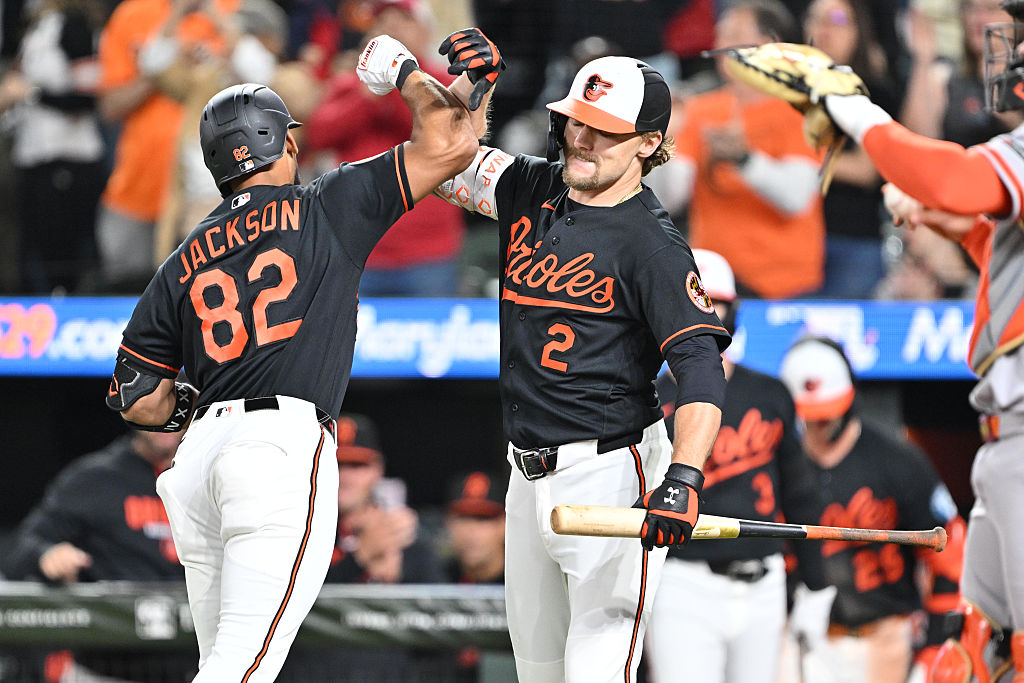
25 games into the season, Leody Taveras leads the team in batting average and on-base percentage, Jeremiah Jackson is second on the team in home runs, and Pete Alonso doesn’t have one of the team’s five furthest longballs.
Just as we all expected.
It’s fair to classify Baltimore’s offense as “odd” to begin the year.
An eight-run outburst in Kansas City propelled the O’s to a series victory. The strong showing offensively bumped the team’s cumulative OPS over .700 to .701, the 16th-best mark in baseball. Their .230 batting average was 18th and .320 on-base percentage 15th. All in all, right around average.
There are some areas where Baltimore excels, and some areas less so. In a choice between good news and bad news, I prefer to start with the bad. Let’s dive into the numbers and not what that choice means about my psychological makeup.
The statistic that has been pointed out more than most is the team’s strikeout numbers. As of mid-day Wednesday, the O’s 236 punchouts were second-most in baseball. However, the much-maligned swing and miss doesn’t directly correlate to offensive success, or, in this case, a lack thereof.
The Angels have struck out over 250 times this season, yet remain in the top-10 in OPS. In fact, five of the top ten teams in total strikeouts are among the top half of the league in on-base plus slugging.
Then, there’s the slow starts.
Despite being middle of the pack in the big three offensive categories, the Orioles rank just 26th in OPS, a .639, in the first four innings of games. They’ve scored just 34 runs, 24th, and struck out 112 times, second-most.
Perhaps the return of Adley Rutschman at the top of the order and Pete Alonso’s good stretch, with an .886 OPS over his last 10 games, can provide a spark out of the gate.
But Baltimore has been finding a way late.
In the seventh inning or later, the O’s vault up to the 11th-best OPS in baseball at .759, a .120 jump from earlier in the game. Even better, in late and close situations, defined as any at-bat in the 7th inning or later where the batting team is leading by one run, tied, or has the potential tying run on base, at bat or on deck, Baltimore has a whopping .968 OPS, second-best in the game.
Four regulars, Taylor Ward, Jeremiah Jackson, Leody Taveras and the smaller sample size of Tyler O’Neill, have an OPS over 1.000 with runners in scoring position. Two more, Rutschman and Weston Wilson, are above .900. Just two returning players, Jordan Westburg and Gunnar Henderson, found that kind of success in 2025.
It’s been those players at the bottom of the order, Taveras and Jackson, that have provided the biggest spark offensively. Jackson’s 19 RBIs pace the team, while Taveras’ 14 ranks third. Colton Cowser and Coby Mayo typically join them at the bottom of the lineup, and while each has gotten off to a slow start offensively, the duo combined to launch a mammoth home run and scorch a double in Wednesday’s win. If that pair can turn things around, Baltimore’s lineup looks dangerous one through nine.
There’s more reason for optimism, too.
While the hot stretches from Taveras and Jackson may not last for the entire season, it’s highly unlikely that Henderson’s batting average will remain below .200 or that Ward and Alonso won’t begin to climb the team’s home run leaderboards. Plus, rookies Dylan Beavers and Samuel Basallo are still learning the ropes in the big leagues, and could hit a stride down the road.
At 12-13, there’s been plenty of up and down results from Baltimore’s offense. But with Rutschman’s return, Alonso’s good stretch and more on the mend, the O’s are hopeful that things will continue to trend in the right direction.
112 Comments
Related Articles
Estrada and Anderson have excellent first impressions in Triple-A Norfolk
The strength of the Orioles farm system is, largely, measured by the talent in the lower levels of…
Read More
Lack of execution and doing “little things” became big problem for Orioles
Any baseball conversation with Orioles bench coach Donnie Ecker reveals an interesting facet of his personality. Of a…
Read More
Orioles shut out again to complete sweep, elimination number is two, Albernaz angered by first-pitch swing
Gunnar Henderson chucked his helmet and bat, stripped off his protective padding and dumped it near home plate.…
Read More