






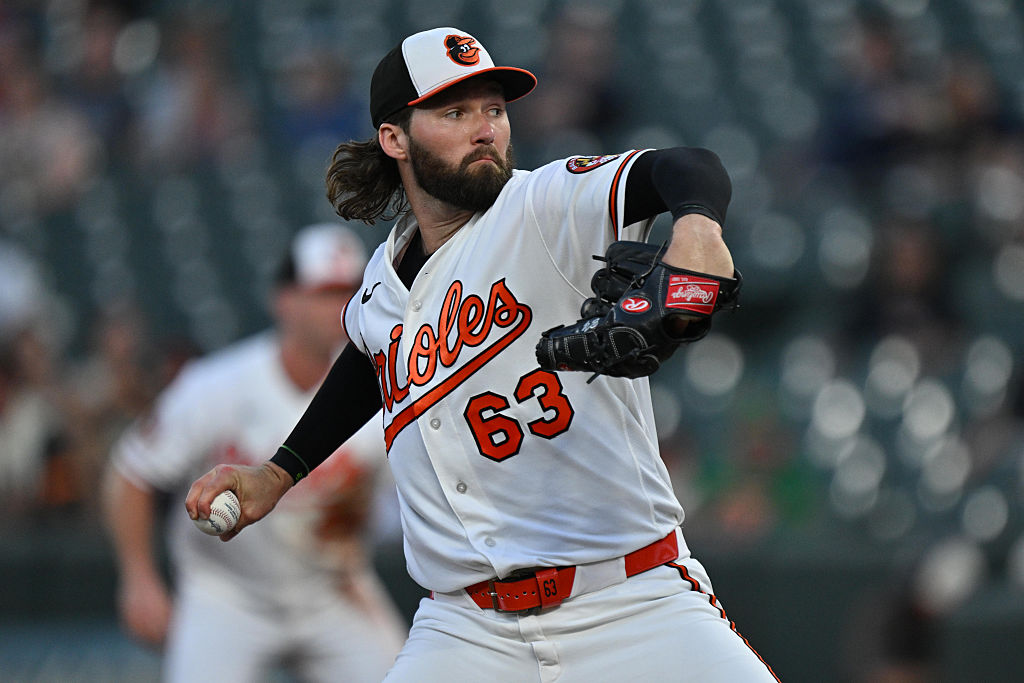
How Brandon Young became a reliable rotation piece in 2026
-

-

November 13, 2026 9:00 am
-

0 Comments
-

The Orioles were deep with starting pitching talent entering the 2026 season.
Trevor Rogers, fresh off a 2025 campaign in which he posted a sub-2.00 ERA in 18 games, earned the Opening Day nod. Kyle Bradish was back, healthy, and right behind him. The newly-acquired Shane Baz made a solid number three, and veterans Zach Eflin and Chris Bassitt rounded things out.
The room was so crowded, in fact, that Dean Kremer, who posted a 3.95 ERA in over 100 starts in the past four seasons, was optioned to Triple-A Norfolk. There, he joined a few younger depth options with some upside: Chayce McDermott, Cade Povich, and Brandon Young.
Young flashed some brilliance in 2025, like on August 15, when he took a perfect game into the eighth inning against the Astros. By and large, though, his season was defined by inconsistency. A promising outing against the Mets in early July, for example, was followed by seven earned runs against the Marlins.
As such, it wasn’t a shock when Young began 2026 with the Tides, seen as perhaps the seventh or eighth option in the rotation. But due to injuries, that number was called quickly.
And when he made his return to the big leagues, we didn’t see the same Brandon Young.
BY finished the season with, arguably, the best 2026 campaign of any Orioles starter. He posted a 3.56 ERA in 28 games and surrendered more than four earned runs in an outing just once.
What changed?
There’s plenty of numbers and data to dive into, but there’s also, simply, the human element of the game. The more sustained success that BY found, the more he felt like he belonged. That’s what Young told us on “The Bird’s Nest,” during the season – success at the highest level had started to become more normal.
Pitching coach Drew French echoed that sentiment back in July.
“I think it is his belief in himself and his confidence,” French told me. “What he went through last year is not easy. In 13 starts, to feel how he had to feel a lot, makes a person think ‘this is going to happen again’ or ‘man, we’re going down the same road.’ … It’s a mental, psychological piece that he had to kind of reframe and flip for himself. He’s put a lot of stock in his mental game this year, and he’s not gone to those places.”
French also highlighted the pitch that was the key to Young’s breakout: the four-seam fastball. According to Statcast, that offering had a run value of plus-10, a top-25 four-seamer in the game based on that metric. It ranked higher than the four-seamers of Paul Skenes and Gerritt Cole.
“He’s really bought into the north-south profile,” French said. “He is a taller guy with a little bit of a lower release height as well, so I think there’s some imagery and a muddy picture that these hitters have to guard against when Brandon Young is on the mound.”
BY threw the four-seamer over one thousand times in 2026, and batters hit just .225. There are lots of potential reasons for that.
First is the north-south profile that French mentioned. Looking at a heat map of that offering in 2026 as compared to 2025, it’s clear that the plan of attack featured that new approach. Plus, Young threw his four-seamer out of the zone about 10 percent more frequently, according to FanGraphs, and hitters followed suit. They swung out of the zone over 10 percent more frequently, and their overall contact rates against the pitch fell.
The pitch itself also moved differently. Young’s four-seamer averaged 94.4 mph this season, according to Statcast, as opposed to 93.8 mph in 2025. Even those small increases can make a significant difference. It had more horizontal movement, too, which could be attributed to Young’s arm angle dropping about seven degrees.
Finally, there’s how it worked off his other pitches. Against lefties in 2026, Young typically threw his four-seamer, splitter and curveball. The splitter underwent significant changes, too, dropping much more and moving about three mph slower in ‘26 as compared to ‘25. A higher speed and movement differential is only going to do good things for both pitches.
The addition of a sinker, used more frequently against right-handers, gave hitters another fastball shape to worry about, too.
The improvement of Young’s slider also became a significant development. He threw it a bit faster, it moved a bit less, and hitters couldn’t connect. The opposition hit just .196 against the pitch with a 41.6 percent whiff rate, an increase of over 20 percent as compared to 2025.
Got all that?
For some more visuals behind this explanation, you can check out my video breakdown below.
The “how” behind Young’s breakout season is multifaceted and complex, but the takeaway is much simpler: the Orioles won a lot of games that Brandon Young started in 2026. He toed the rubber 28 times, and Baltimore went 19-9 in those contests. That includes nine of the first 10, all of his starts in May, and all of his starts in July.
Young may have entered 2026 as a depth piece in Triple-A, but he left it as a solid part of the big league rotation going forward.
0 Comments
Related Articles
Reviewing upcoming deadlines and what’s currently known about the Orioles
President of baseball operations Mike Elias, general manager Jared Banner and the rest of the Orioles’ contingent returned…
Read More
Orioles sifting through player and market choices in attempts to improve roster
Recent strategies to upgrade and strengthen the Orioles’ rotation have consisted of making trades, signing veterans to one-year…
Read More
Mountcastle feels good and is waiting to find out which team might benefit from it
Ryan Mountcastle is healthy again. His oblique has healed and he’s back in the gym, swinging a bat…
Read More