








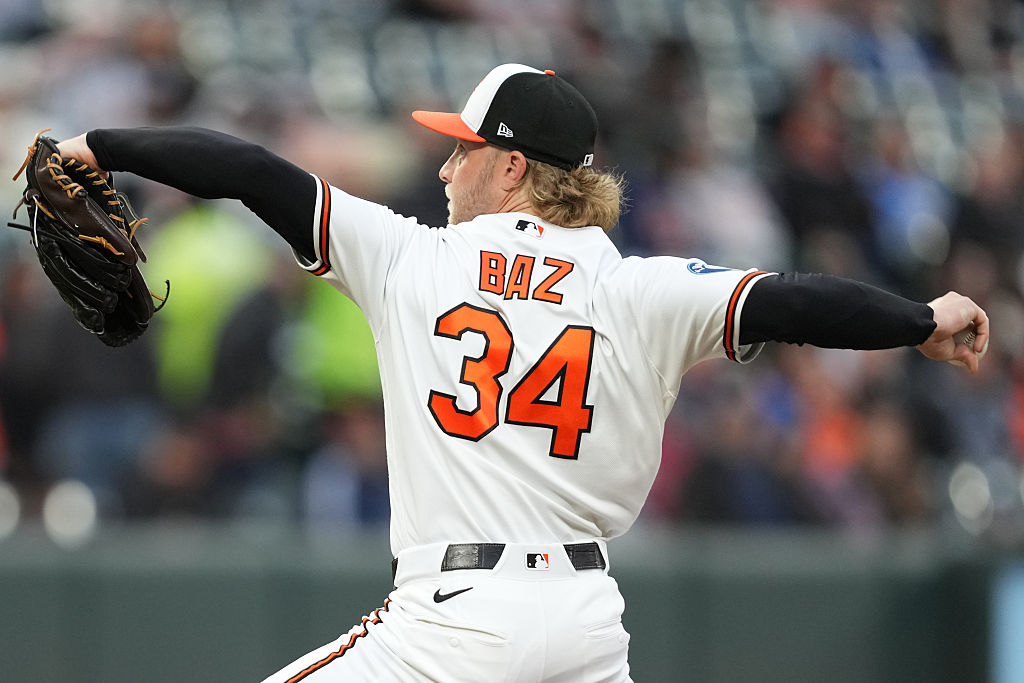
Attack mentality leading to better results for Baz
-

-

May 29, 2026 8:00 am
-

183 Comments
-

Shane Baz didn’t overhaul his mechanics ahead of his ninth start to the season. He didn’t add a new offering, though he had entering the season, nor did he completely change his pitch usage.
A 5.48 ERA entering play against the Washington Nationals on May 15 for outing No. 9 wasn’t the ideal figure to begin an Orioles tenure. The right-hander, an offseason trade acquisition, had allowed five earned runs in back-to-back outings and was about to square off against the highest scoring offense in baseball in the nation’s capitol.
That night in D.C., he threw a few more cutters, but largely relied on his four-seam fastball and knuckle-curveball combination as usual, and tossed seven innings of three-run baseball. An encouraging step in the right direction, even with a similar approach that hadn’t yet garnered positive results.
The next evaluations came against the Rays, the team that dealt Baz to the Orioles back in December. Tampa Bay has been making pitchers miserable all season with their contact-first, strikeout-free approach. And yet, Baz passed each test with flying colors, tossing 13 innings and surrendering just two runs with 15 strikeouts in back-to-back starts against his former team.
Sometimes, changes don’t have to be flashy. They can be as simple as mindset, approach and execution.
“I would say the biggest difference is the first-pitch strikes,” Baz said when asked to summarize the difference in his last three starts. “Less walks, which kind of go hand in hand, I think. Just making better pitches with runners on base. I think that’s always where you make your most important pitches, with guys on base and guys in scoring position. I think it’s just been a better mentality and better focus when I do have those runners on and runners in scoring position. I think that’s been the biggest difference.”
Tuesday’s outing against the Rays, in which Baz tossed seven innings with one earned run and nine strikeouts, was emblematic of that simple, yet effective, shift. The righty landed nearly 58 percent of his pitches in the zone, four percent higher than his prior season-high, set, as you may have guessed, in his previous outing. His nearly 76 percent first-pitch strike percentage, according to FanGraphs, smashed his old season-high of 64 percent, too, and he, Grant Wolfram and Andrew Kittredge combined to limit Tampa to a 1-for-7 day with runners in scoring position.
Noting that pitchers are much more effective when ahead in the count isn’t breaking news, but the stark difference is noteworthy. Entering Thursday’s contests, only 10 teams in baseball had a batting average of .200 or better when behind in the count. Conversely, the worst team batting average in the majors when ahead in the count was .249, and 11 teams hit at least .275.
In Baz’s case specifically, getting ahead really opens up his arsenal.
“I just think that when you’re ahead 0-1, you don’t have to be as perfect,” he said. “It kind of puts you in the driver’s seat of making the hitter swing the bat. And, vice versa, when I am 0-2, 1-2 or 2-2, I don’t have to be in the zone. I don’t wanna leave a pitch over the middle of the plate. I think just those differences are what makes good from bad a lot.”
In that driver’s seat, the former top prospect prefers to go to his strikeout pitch: the knuckle curveball. Over the last two outings, that pitch’s putaway percentage, the rate of two-strike pitches that result in a strikeout, hit 40 percent, the only two times the pitch has reached that height this season, according to Statcast. In fact, that offering has resulted in 15 of his last 19 strikeouts, as opposed to accounting for just 17 of 38 in his first eight starts.
“I don’t have to show it [the knuckle curve] to a hitter until there’s two strikes a lot of the time,” Baz said. “It’s going to be a lot harder to hit and recognize if it’s their first time seeing it. I think that’s been a big difference this year, not having to live off that pitch early in the count. When the time calls, I can flip one in for a strike, but being able to get ahead with my other stuff and use that as just a knockout punch.”
The four-seam fastball has been much more effective since that outing against the Nationals, too. In Baz’s last 3 starts, according to Statcast, opponents have hit .222 against the heater. In the previous 8, opponents were hitting .313. With a new two-seam fastball, the 26-year-old can mix looks with the four-seamer, cutter and changeup.
“The command has been really good the last few outings, and when you have that, you can play every lane of the plate, high and low, and it just kind of opens up so much for me against righties with the two-seam,” Baz noted. “Lefties, when I can spot my four-seam up and in, down and in, up and away. It opens up the changeup, something that comes out looking like a fastball can keep them off balance, where they can’t just pull everything if there’s the changeup going away from them. It’s just been good to have all my stuff in these outings. It just gives you way more options and weapons.”
Improvement doesn’t always have to mean major change. Perhaps it can be as simple as better execution. Baz’s talent and impressive arsenal have always been in the tank. And after signing a five-year contract extension in Baltimore, these consecutive impressive outings could be a sign of better things to come.
183 Comments
Related Articles
Taking another dip in the mailbag
Nothing new to report with the Orioles. Cade Povich’s elbow cleanup was the most recent offseason surgery. Pitcher…
Read More
This, that and the other
Part of the Orioles’ offseason business is making decisions on players with options for 2027. Only one of…
Read More
Five surprising occurrences from the Orioles’ 2026 season
The unpredictable nature of baseball didn’t skip over the Orioles. I guess we could have anticipated injuries and…
Read More