








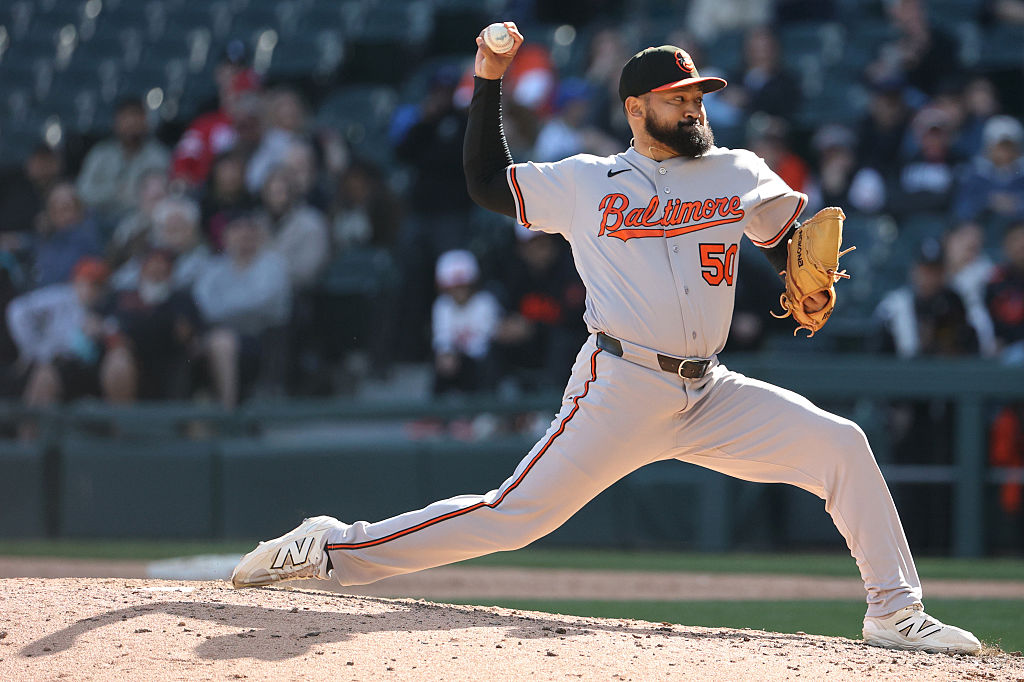
Distinct movement on Garcia’s secondaries becoming separator
-

-

April 16, 2026 8:00 am
-

225 Comments
-

It goes against conventional wisdom that a pitch having less movement could be a good thing.
An airbender changeup, a wipeout slider or a curveball that drops off the table are valuable tools to have in the kit. Most likely, you wouldn’t think the same of a changeup that doesn’t drop, a slider that doesn’t break, or a curveball that has no horizontal movement.
But for Orioles reliever Rico Garcia, the lack of movement on his secondary offerings, in certain areas, may just be to his benefit. The pitches aren’t “bad”: his nine innings of hitless baseball, 100th percentile expected ERA and 99th percentile expected batting average would say otherwise. They’re just “different.”
The movement of Garcia’s changeup, slider and curveball go against the grain. But their differences may just be what’s leaving hitters hitless.
His changeup doesn’t behave quite like a changeup at all. According to Statcast, Garcia’s change averages just 22.4 inches of vertical drop, the third-fewest in the big leagues. That’s nearly 10 inches less than other changeups within two miles per hour and 0.5 feet of extension/release of García’s, the second-biggest difference in the majors.
Conversely, it has 15.4 inches of arm-side run, meaning, in this case, that the pitch moves from left to right, as Garcia’s “arm side” is to the right as a right-handed pitcher. Dylan Cease was the only pitcher to have a bigger comparable difference in vertical break, and his changeup only averages 9.8 inches of run.
Typically, a hitter would anticipate a changeup dropping somewhere from 30 to 40 inches. Knock 10 off, and that batter is whiffing, which they have been on that changeup a whopping 75 percent of the time.
Less is more.
Garcia’s curveball essentially does the opposite: there’s basically no horizontal movement. The pitch, delivered against both righties and lefties, moves just 0.5 inches to Garcia’s glove side, the third-fewest amount of movement of any curveball in baseball.
The same concept applies: hitters are anticipating that the pitch will move east-west, and when it doesn’t, the righty misses bats.
Finally, there’s the slider. It averages about 88 miles per hour, faster than a typical slider. In fact, it’s closer to a cutter’s velocity, a pitch that shares similar movement characteristics.
Garcia’s hard slider has just 29.7 inches of vertical drop, 4.5 inches less than comparable offerings, according to Statcast. It doesn’t move much horizontally, either. While 29.7 inches of vertical drop isn’t much for a slider, it’s still much more than a typical cutter. So, with a cutter’s velocity and a good bit of drop, it’s no wonder that hitters have been over the top, contributing to García’s 97th percentile groundball rate.
That piece of the arsenal is one that’s new for the veteran. Before implementing it into his game more regularly, right-handers had dominated Garcia with a career OPS above .900. A reverse-splits reliever could still be valuable, but with the three-batter minimum, it was tough for the reliever to find a place.
Now, with that slider to attack right-handers, Garcia can face anyone in the opposing lineup, no matter which batters box they step into.
Ironically, the veteran’s primary pitch, a four-seam fastball, has both a good vertical and horizontal movement profile. That pitch doesn’t do anything off kilter, it’s just a really good offering.
Heading into the season, Baltimore’s bullpen didn’t have many established names. But with how he’s pitched to begin 2026, Garcia’s name will be one of the first ones called in high leverage.
225 Comments
Related Articles

Estrada and Anderson have excellent first impressions in Triple-A Norfolk
The strength of the Orioles farm system is, largely, measured by the talent in the lower levels of…
Read More
Lack of execution and doing “little things” became big problem for Orioles
Any baseball conversation with Orioles bench coach Donnie Ecker reveals an interesting facet of his personality. Of a…
Read More
Orioles shut out again to complete sweep, elimination number is two, Albernaz angered by first-pitch swing
Gunnar Henderson chucked his helmet and bat, stripped off his protective padding and dumped it near home plate.…
Read More